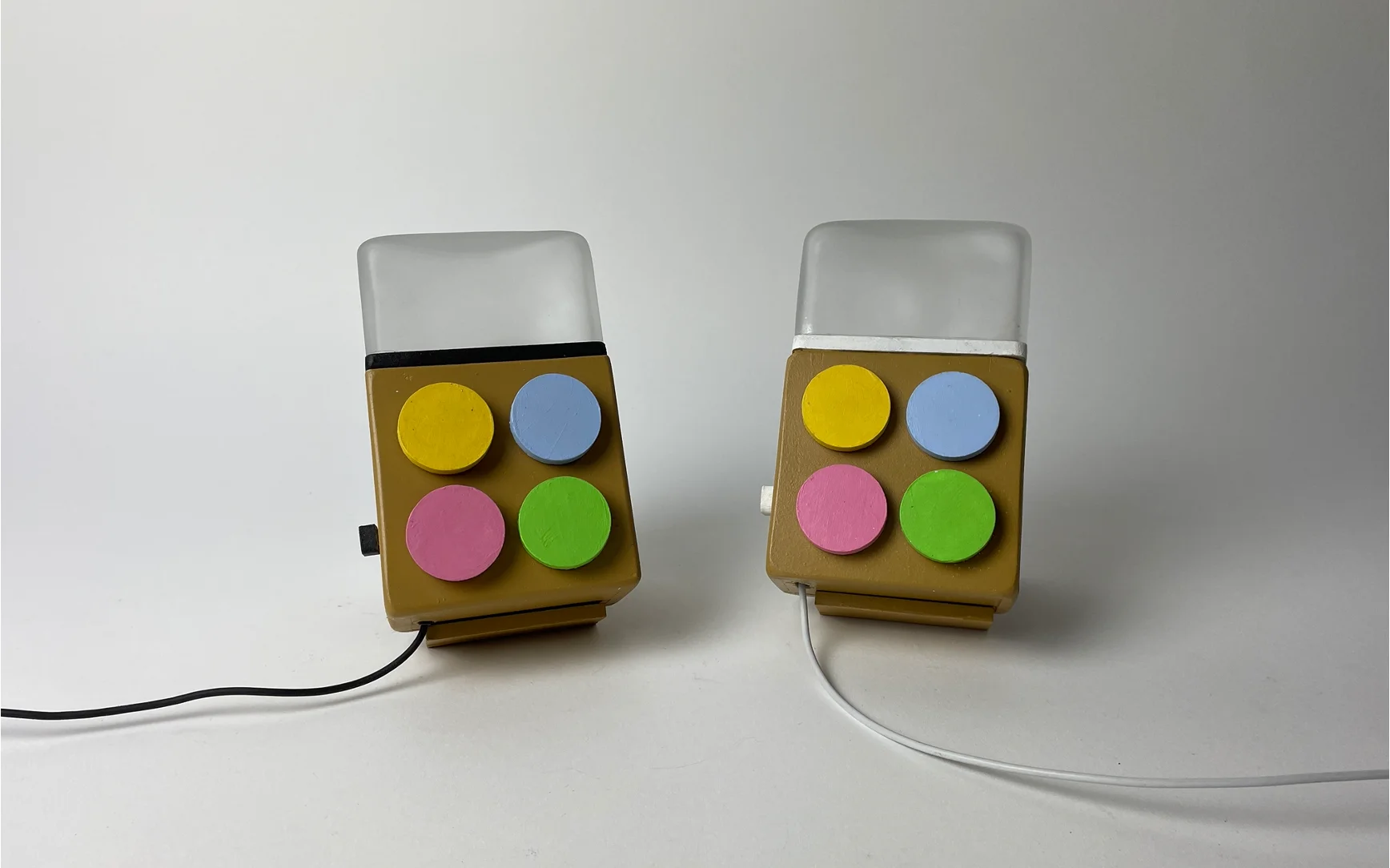
Project 04 — Milo
Year Jan 2023 — May 2023
Context University of Edinburgh
Role With Quentin Bachelot · concept, prototyping, code

A connected memory game for people who live apart.

A pair of small, tactile devices that let two people play Simon together across any distance, in light, rhythm, and memory, no screens, no chat, just a quiet conversation that builds over days.

Connected Things Tangible UX Emotional Tech Interaction Design Prototyping
The Milo pair, two small wooden devices with four pastel buttons and a glass-blown diffuser top, sitting side by side
§ 01 Problem distance, quietly

Loved ones live apart, and most ways of keeping in touch are loud.

Long-distance relationships rely almost entirely on screens, calls that need scheduling, texts that pile up. The small, mundane signals of closeness don't have a digital equivalent. Milo is a screen-free way to leave each other those signals, played as a game.

"I love how nostalgic and calming it feels. I'd actually use it with long-distance friends."
, Play tester · Edinburgh, 2023
92%
of international students in the US report missing the familiarities of home (UNESCO)
49%
believe not having family or friends nearby affects their academic performance
70%
of men and 55% of women aged 18 to 34 say games help them stay connected (ESA)
65%
of video game players play with others, connection, more than competition
§ 02 Concept like Simon, across distance

A rhythmic conversation, played in light and memory.

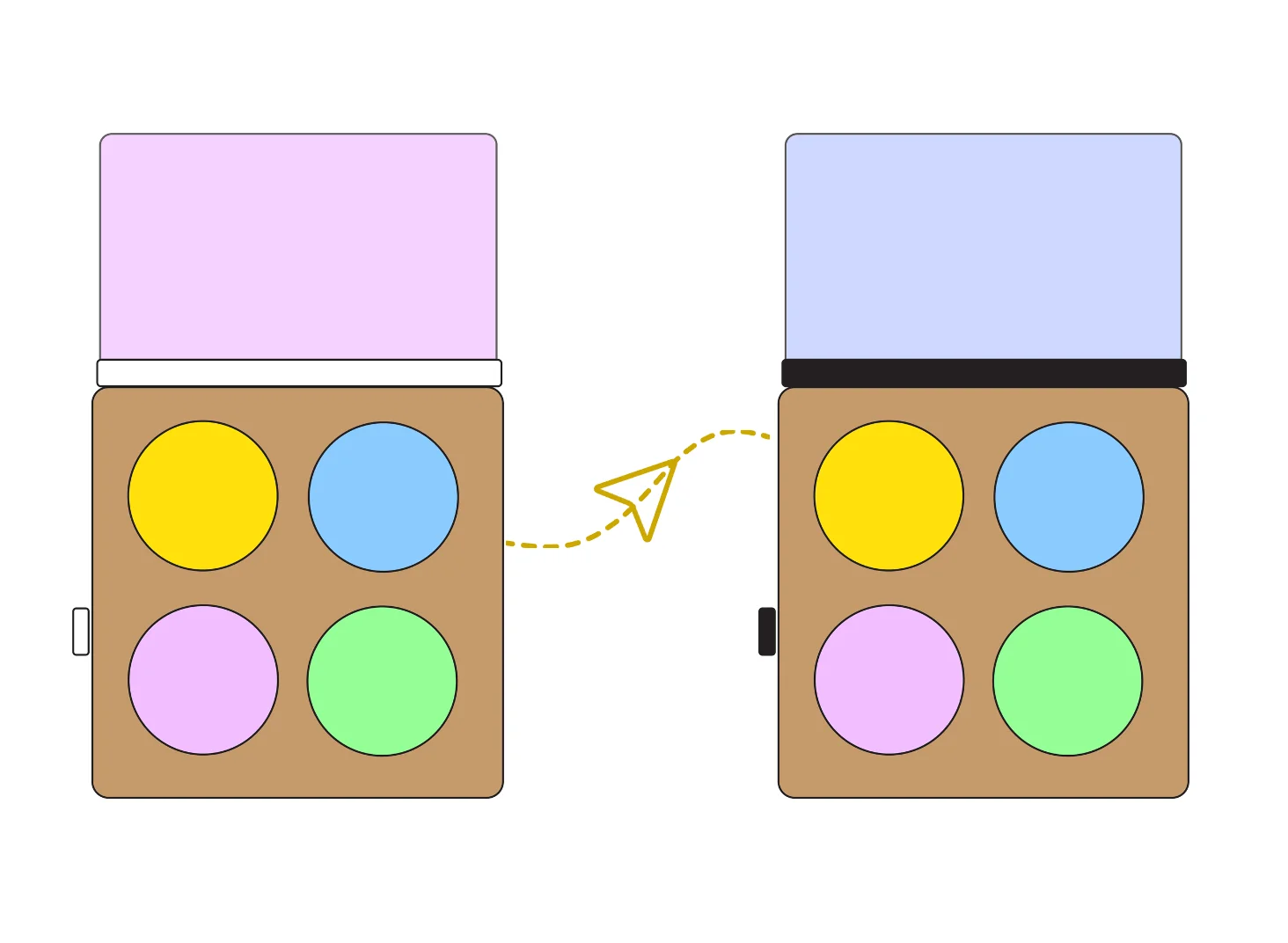
Two devices, paired over the cloud. One person taps a sequence of colours; the other receives it, watches the lights play it back, repeats it, and adds one more. Get it right and play on. Get it wrong and the other player scores, and a new round begins.

A pair of small wooden Milo devices, one with a white connector top and one with a black, four pastel buttons on each, with a dashed paper-airplane arrow between them showing how a sequence travels from one to the other
A sequence travels between the two devices, one round at a time. Watch demo ↗
  1. 01

    Start the sequence

    Player 1 taps three colours to begin a new game.

  2. 02

    Receive the sequence

    A blue light signals it's your turn. Press the side button when you're ready to play.

  3. 03

    Watch and remember

    The NeoPixel ring plays back the colour sequence sent by the other player.

  4. 04

    Repeat, then add one

    Tap the sequence back on the four coloured buttons. Add one more colour at the end to extend the round.

  5. 05

    Nailed it

    Flashing green and a rising beep. The longer sequence travels back to the other player.

  6. 06

    Miss it

    Flashing red and a falling beep. The other player scores a point and starts a fresh sequence.

A rhythmic conversation, played across time and space.

§ 03 The pivot when the rough one won

The cardboard prototype kept winning the tests. We listened.

The first design was a fixed object, sized to sit on a shelf at home, with a turn-light readable from across the room. It was almost complete when testing started telling us a different story.

First direction

Fixed and visible.

The fixed Milo prototype: a larger, almost-complete enclosure with the four pastel buttons on its top surface, sitting on a desk
What testers chose

The cardboard rig.

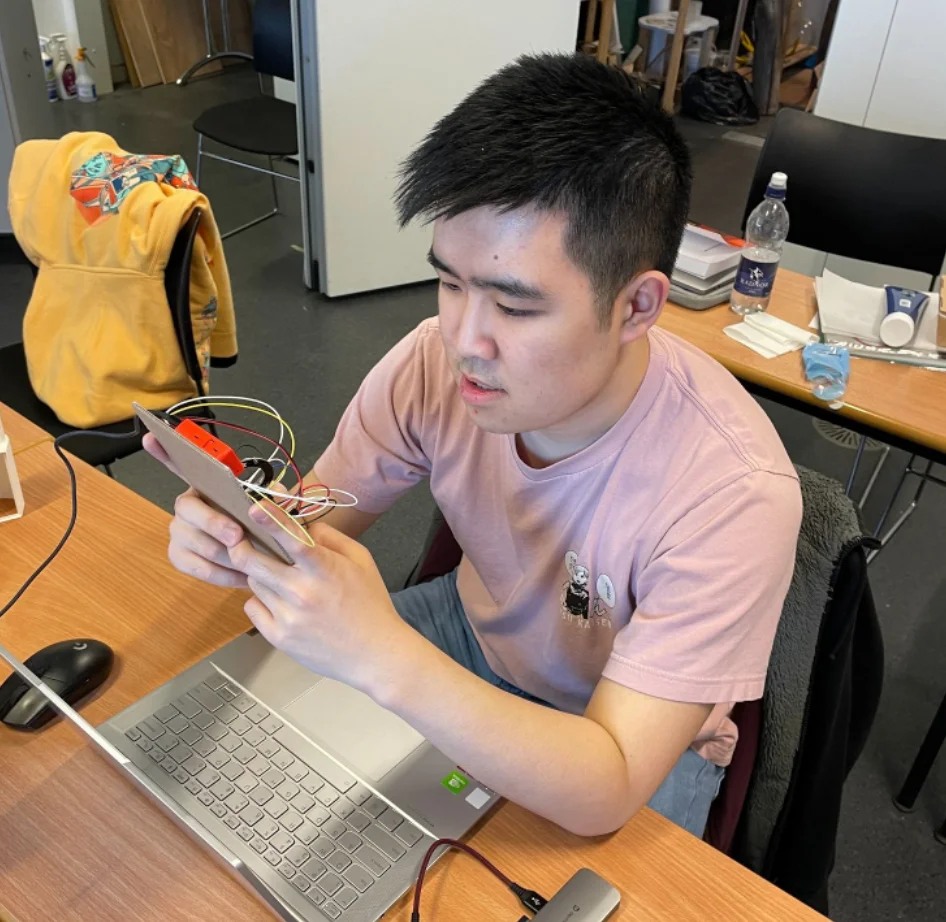
The cardboard electronics test rig: an exposed circuit on a rough cardboard housing with four buttons within a hand-sized footprint
"Testers, including ourselves, kept preferring the cardboard electronics prototype over the actual one. We had been biased by the original Simon and hadn't designed for the way young adults actually pick things up."
, Design journal · Iteration review, mid-project
Resolution

Translated, not redesigned.

The new direction kept the design language of the fixed version, rounded square, wood, pastel buttons, and shrank it to hand size. Two units, paired and visually distinct: white diffuser cap for Player 1, black for Player 2. The colour distinction lives in the form itself, not just the app or the wiring.

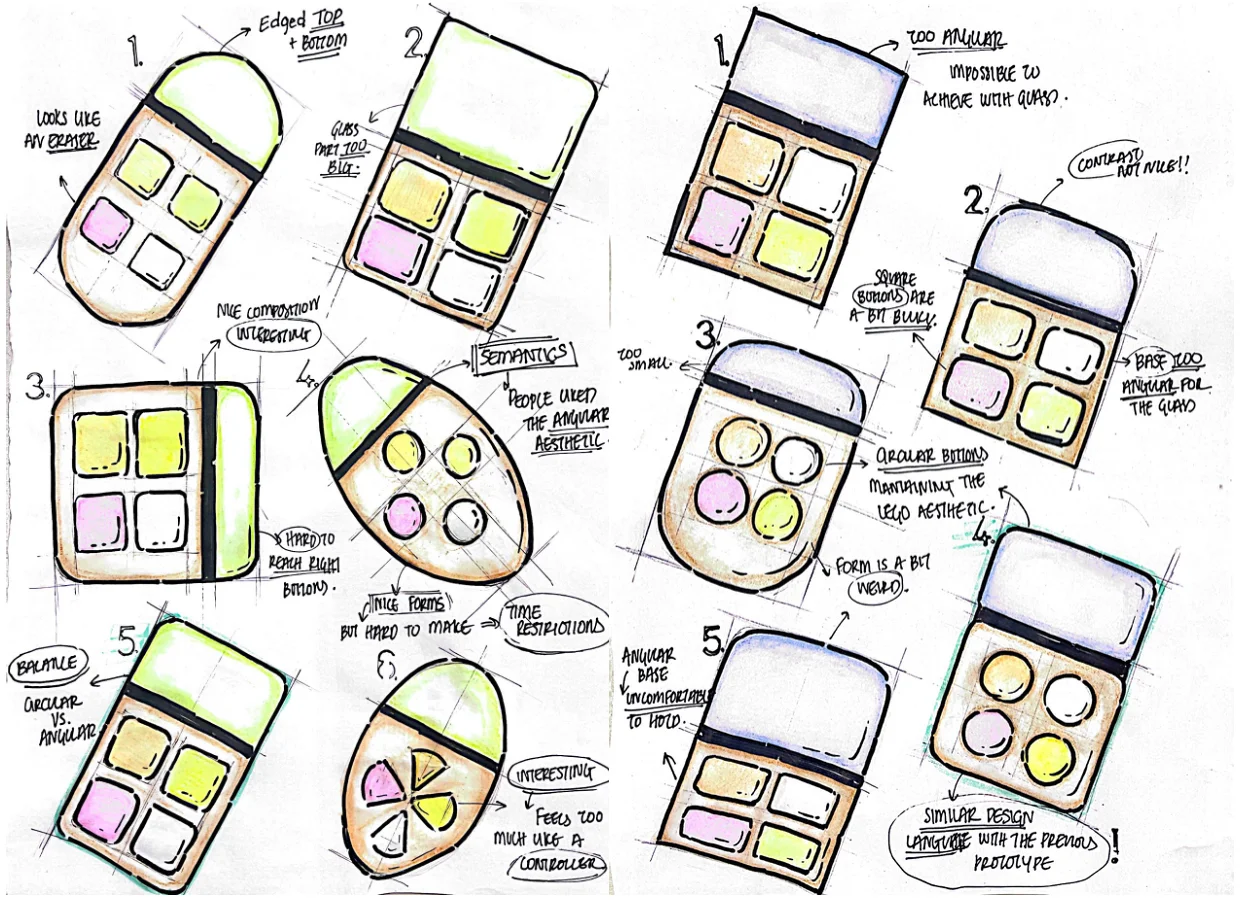
Sketch resolution sheet exploring rounded square forms with rounded buttons, annotated with critiques
Resolution sketches. The rounded square, shrunk to hand size.
§ 04 Making wood, glass, and pastels

Playful, but not childish.

Milo is an "adult toy", which made the CMF choice tricky. Pastel buttons on wood gave the playfulness without tipping into youth product, and kept a quiet line of sight back to the original Simon: nostalgia without imitation.

Form

Operated with the thumb.

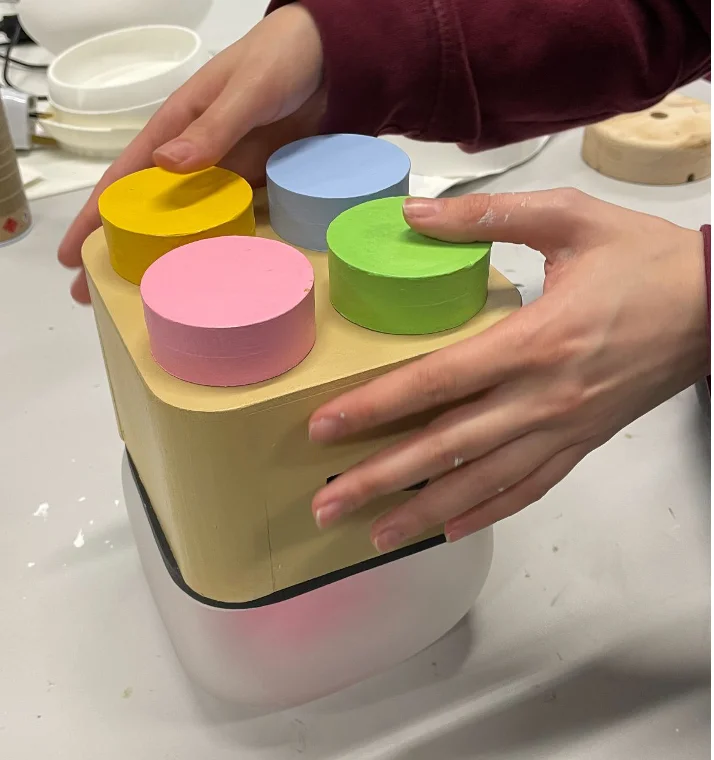
Sized to be held like a small game controller. The side button for "ready to play" sits under the index finger.

Palette

Pastel over bright.

Bright primaries would read as a children's toy. Muted pastels keep the Simon-coded colour memory but feel calmer and more adult.

Diffuser

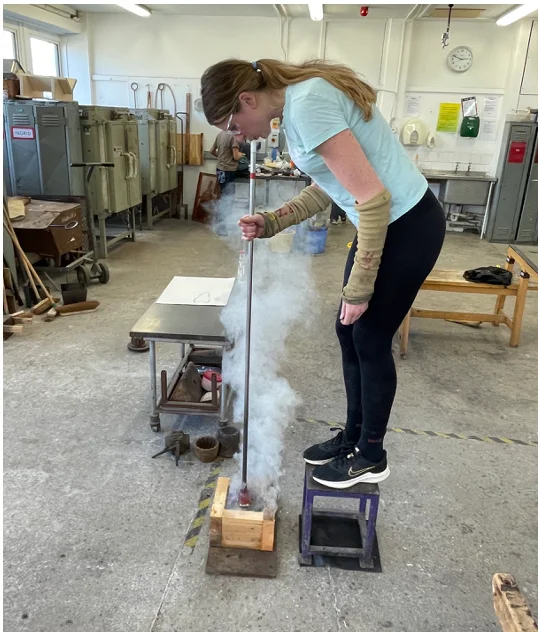
Glass-blown, sandblasted.

The blown-glass cap diffuses the NeoPixel into a soft glow. White cap = Player 1, black cap = Player 2.

From flat sheets to a working pair.

The second prototype (after the pivot) was rebuilt from scratch in roughly two weeks. Laser-cut MDF for the housing, hand-blown glass for the diffuser, and laser-cut layered button caps.

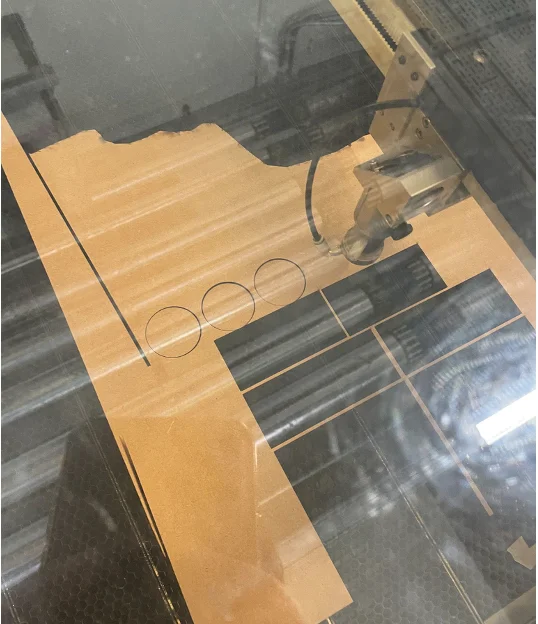
Sheets of MDF being laser cut into the parts that form the rounded square casing
01 Laser-cut MDF Casing parts and stands cut from flat sheets, then glued and sanded into the rounded square form.
Hot glass being blown into a wooden mold to form the square diffuser caps
02 Glass-blowing A wooden mold gave the square shape; the diamond saw cut to height; sandblasting diffused the light.
Laser-cut layered MDF button caps in pastel colours, glued together to achieve the required thickness
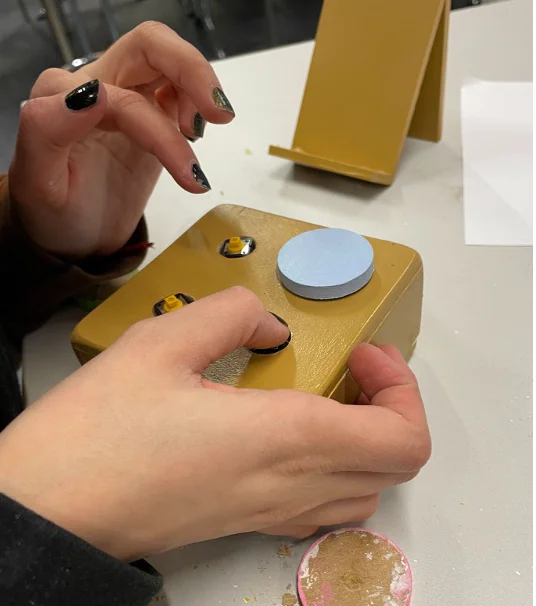
03 Layered button caps MDF laser-cut and stacked to the right thickness, then primed and painted in the four pastel tones.
The finished pair being assembled: glass cap joined to MDF connector piece with epoxy, then bonded to the casing
04 Assembly Glass to connector with two-part epoxy; connector to casing with PVA. Back panel screws on for electronics access.
Working together

Most of the project ran in true collaboration. The split that emerged: I led sketching, and mind-mapping; Quentin led CAD and digital renders. Code, electronics, testing, physical making and the design judgement around the pivot were shared decisions.

§ 05 Electronics five parts, one cloud

One M5 Stick, two units, one shared cloud.

Each Milo runs on an M5 Stick C Plus, an ESP32-based microcontroller with Wi-Fi and a built-in LiPo battery. The two units talk to each other through Adafruit IO: each press writes to a cloud feed, the partner unit subscribes and plays it back. Game state lives in the cloud, so the two players never need to be online at the same time.

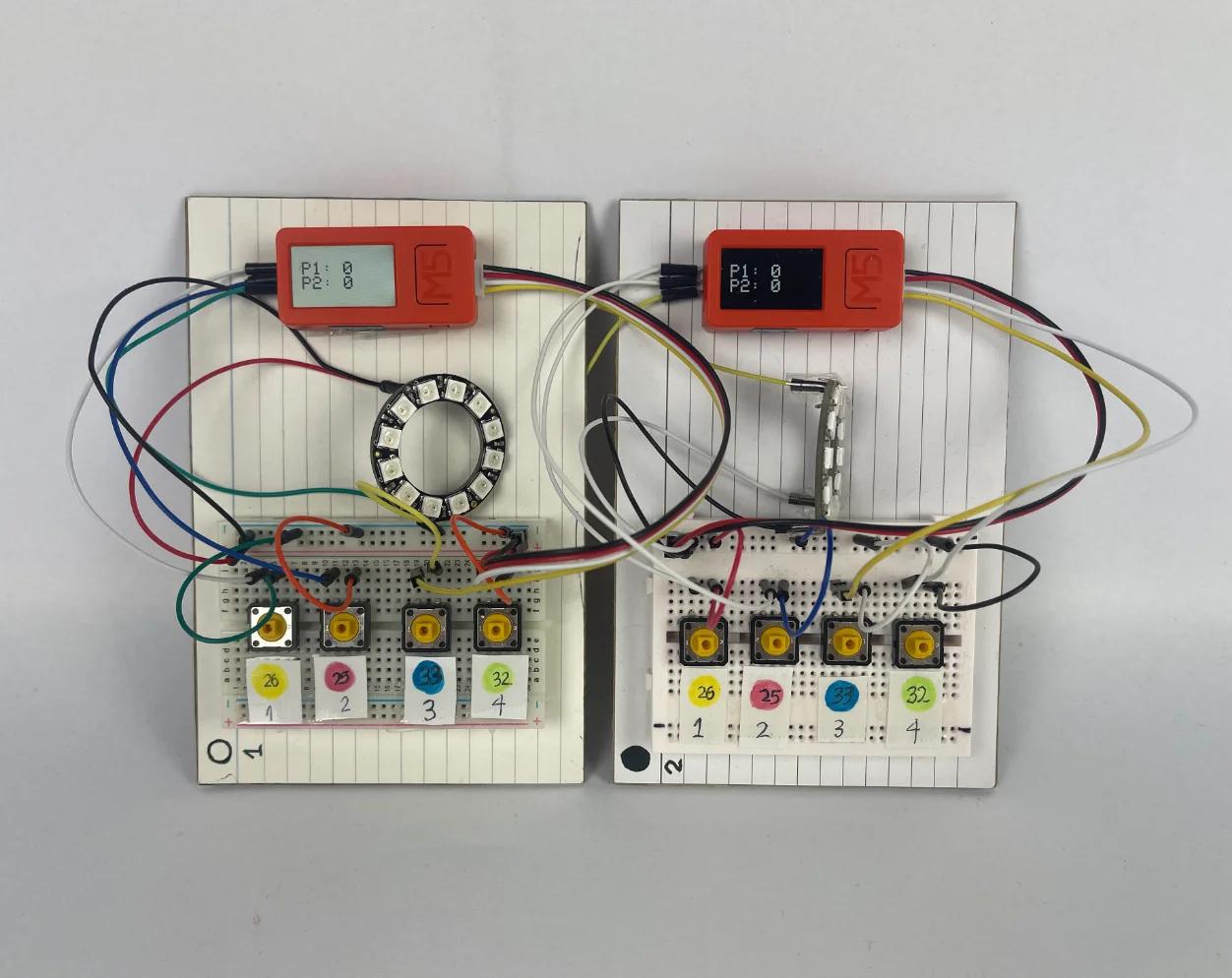
it actually works The Milo electronics laid out: two M5 Stick C Plus boards, NeoPixel ring, four push buttons, a speaker, and a side button, all wired together on a breadboard during testing
The full electronics for one unit, photographed on the breadboard during testing.
  1. 01

    M5 Stick C Plus, ESP32-based

    Runs the code, handles Wi-Fi, and pushes button events to Adafruit IO. Built-in LiPo battery means the device is portable; the built-in screen is repurposed as a small score readout.

  2. 02

    Four push buttons, one per colour

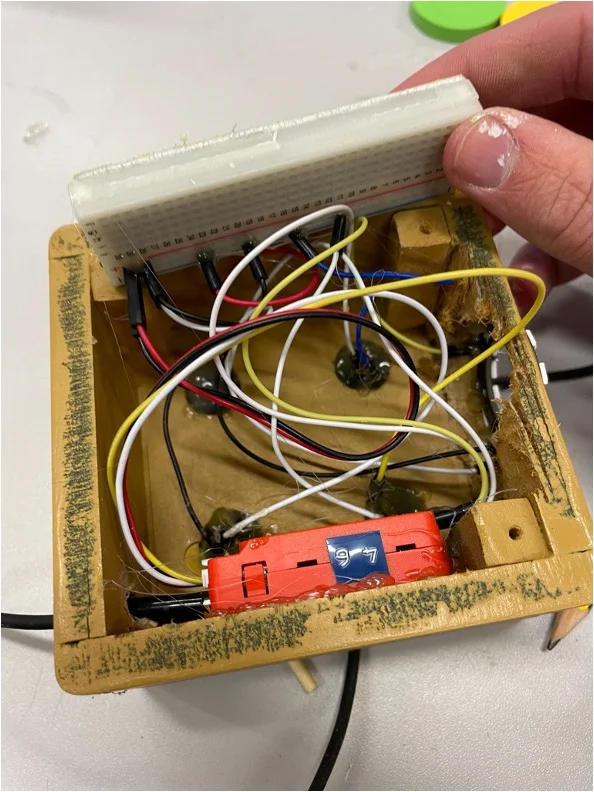
    Soldered into the casing rather than left on the breadboard so the layered laser-cut caps could sit flush. Each press writes a colour ID to the cloud feed.

  3. 03

    NeoPixel ring

    Mounted under the glass cap. Plays back the colour sequence, signals turn state (blue = your turn, green = correct, red = wrong), and animates the win/loss beeps.

  4. 04

    Side button

    Re-uses the M5's built-in button, extended into the casing with a small wooden dowel and a painted cap. Used to confirm "I'm ready to receive the sequence."

  5. 05

    Speaker + Adafruit IO

    A small piezo speaker plays the rising and falling beeps for win and loss. Adafruit IO carries the two feeds (send + receive) that connect the pair across distance.

§ 06 Testing in a room, across one

Tested twice. Once in a room, once across one.

The second phase mattered most: we each took a unit home and played for a couple of days, to test the design where it was actually meant to live.

Playtesting compilation, studio and at-home rounds.
Phase 01 · Studio
Worked

Button feedback "ideal amount of wonky". Beeps clear. Right level of difficulty.

Didn't

"Add a colour" cue unclear. Unit could be thinner. Some pastels confused at a glance.

Phase 02 · At distance
Worked

Prompted texting between rounds. Felt sense of connection even with no contact. Spread-out rounds genuinely harder.

Didn't

Could get repetitive over a long stretch without gameplay variation.
Further developments
  • Slimmer body · a custom PCB would let the unit halve in thickness.
  • Base as charger · the stand should charge on contact rather than plug in.
  • Resilient state · the game should survive a power cycle by persisting in the cloud.
§ 07 Final outcome the pair, resolved

The resolved pair.

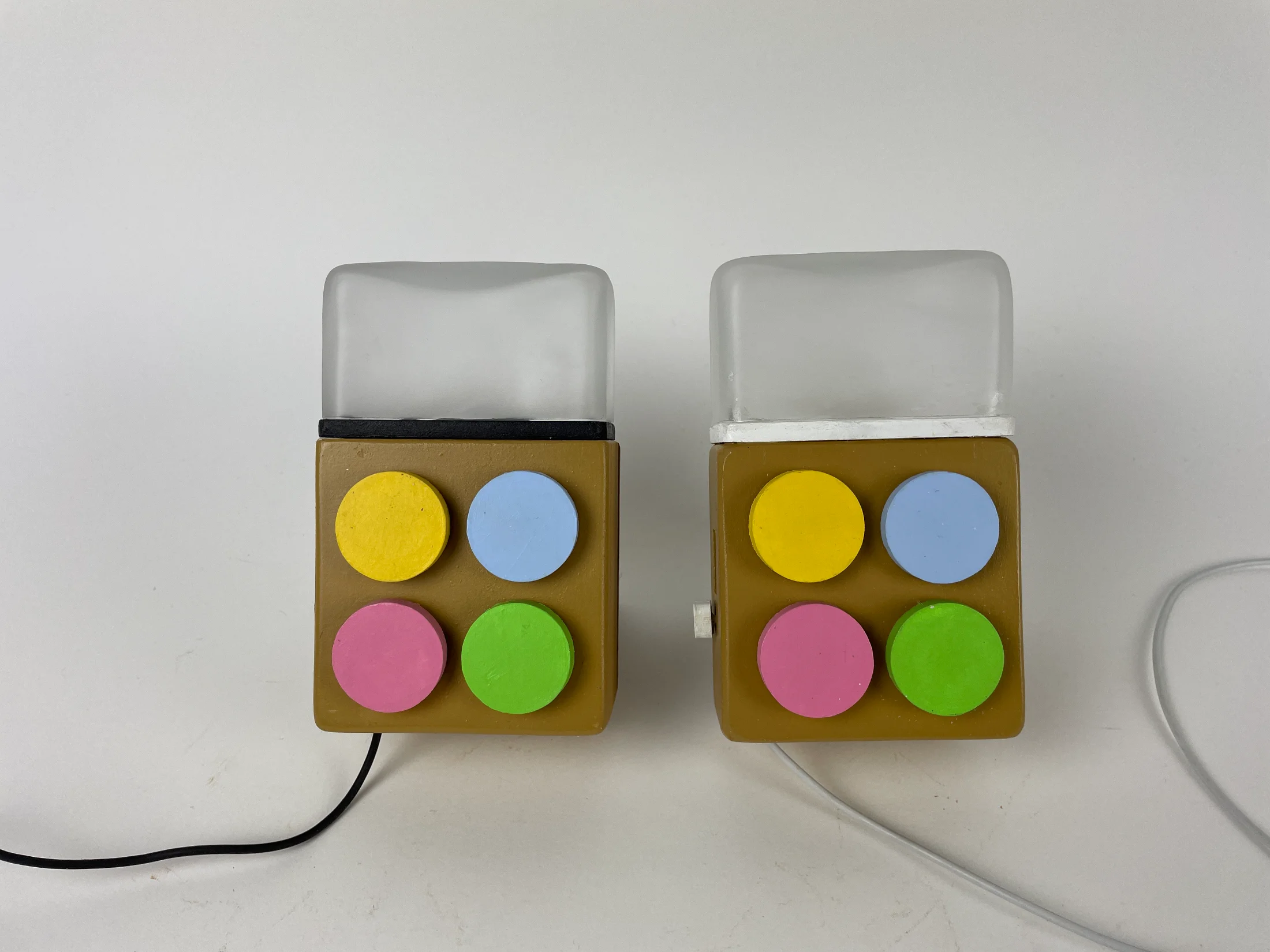
the final pair The resolved Milo pair photographed together, white and black diffuser caps lit, four pastel buttons visible on each
The pair, side by side. White and black diffuser caps.
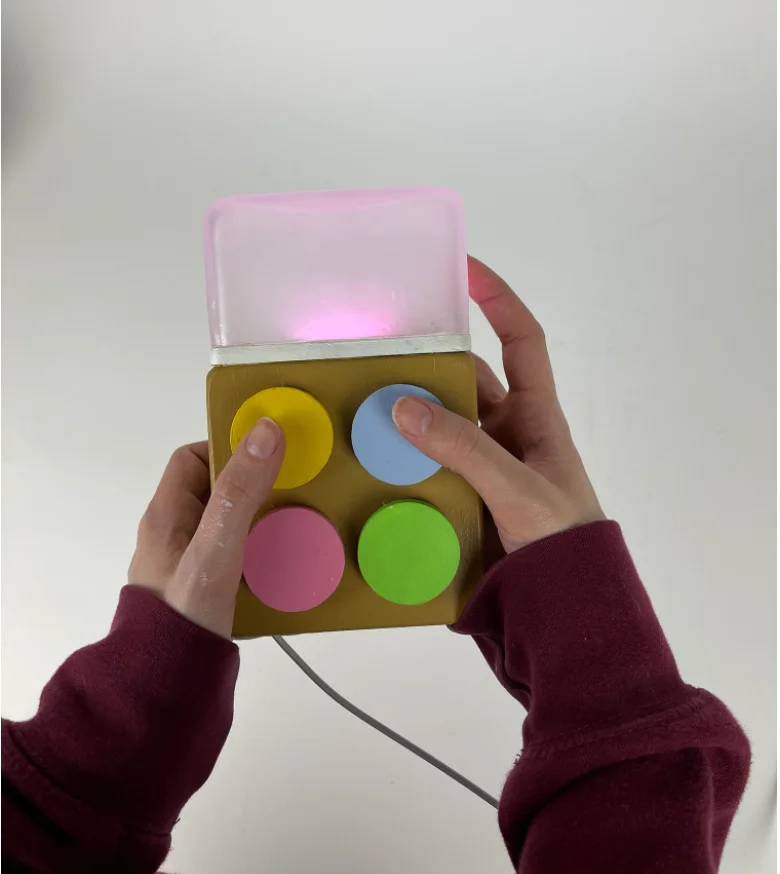
A single Milo unit held in one hand, thumb on a pastel button
In hand. Glowing pink.
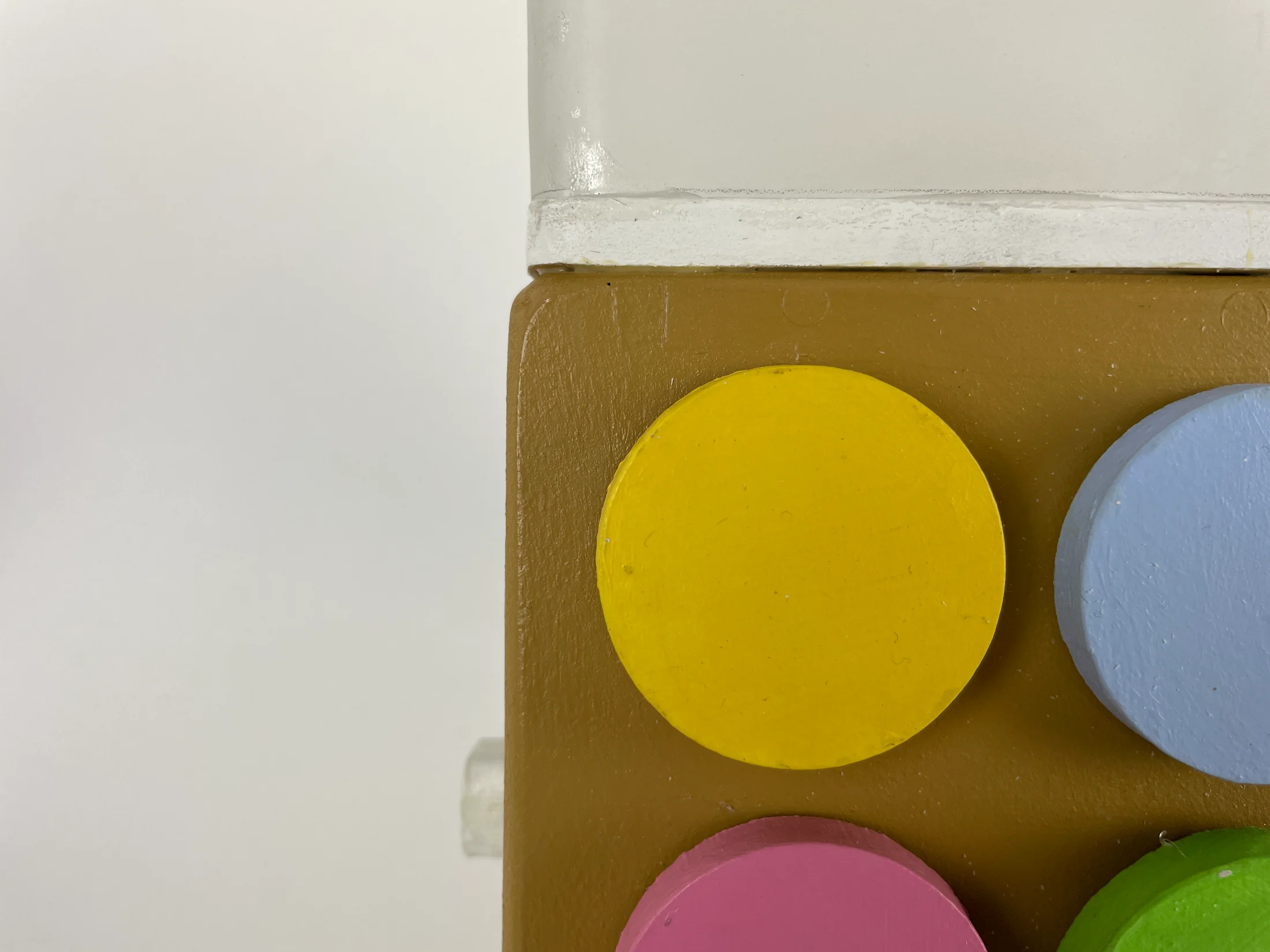
Detail of the NeoPixel glow through the sandblasted glass diffuser cap
Cap detail. Four pastel buttons.
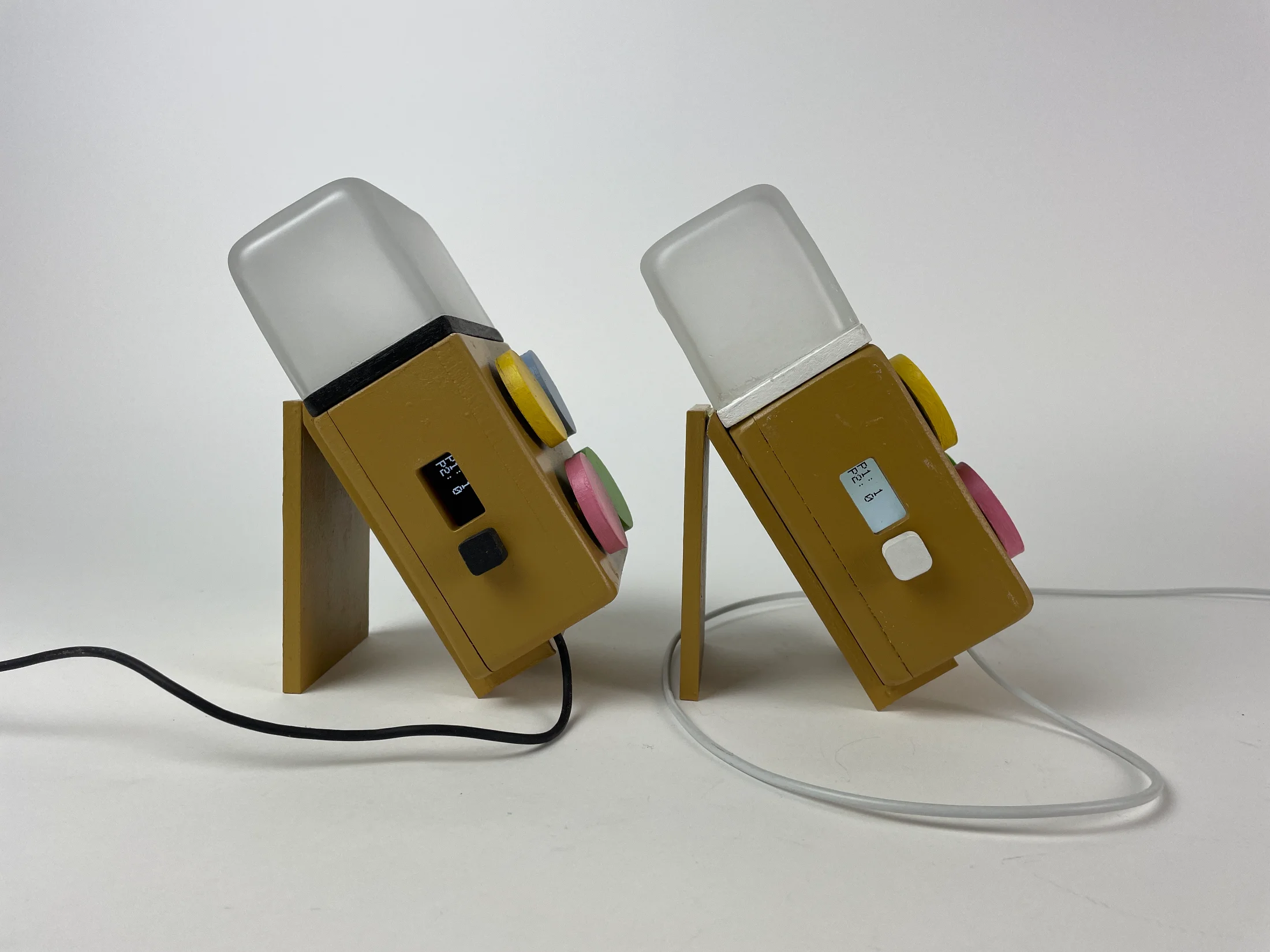
Both Milo units on their stands, side by side on a desk
On the stands. At rest.
Demo: a full round across the pair.